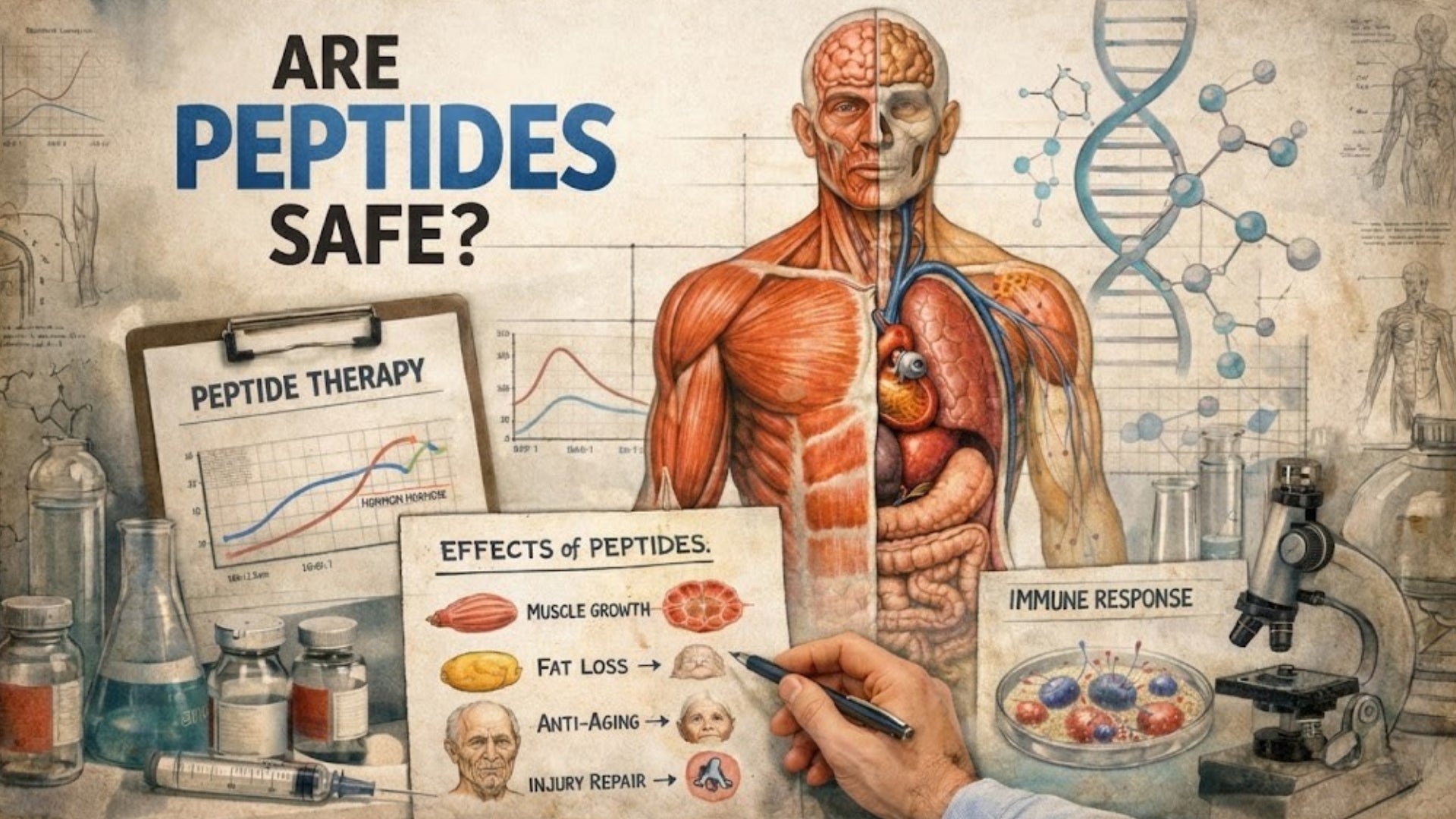
Peptide Purity Decision Innovative Peptides-peptide Medicine Discovery
Peptide Pureness Overview 98%, 99% & Research-grade Described Prg
An example could create a clean-looking chromatogram with one leading peak and still be the wrong compound if identity was never ever confirmed. HPLC measures separation and family member peak area; mass spectrometry steps mass-to-charge actions that can be used to confirm molecular identity. Peptide pureness testing is the process of confirming that a peptide example has only the intended sequence-- and no significant contaminants or byproducts from synthesis. Because peptides are developed via complicated chemical processes, trace contaminations can develop normally. Testing enables researchers to comprehend specifically what remains in the vial, confirming both identity and quality. Choosing a reputable third-party laboratory is crucial to getting trusted peptide recognition results.
Very couple of industrial study peptide suppliers provide MS/MS information on routine COAs-- it is typically booked for pharmaceutical-grade products and advanced research study setups. Nevertheless, some costs suppliers do offer it on ask for crucial sets. If sequence verification is crucial for your study, this is the evaluation to demand. It divides the components of an example based upon their differential affinity for a stationary stage (column packaging product) and a mobile phase (solvent system relocating via the column). Peptides, with lengthy molecular series and varied conformations, present obstacles for framework verification and web content decision. BOC Sciences leverages high-resolution mass spectrometry, LC-MS/MS, and NMR to properly evaluate molecular structures and provide highly delicate measurable support.
During solid-phase synthesis, each amino acid coupling step has a return of roughly 99-- 99.8%. When a coupling stops working, the expanding chain is topped to stop further elongation of the incorrect series. The outcome is a peptide that's much shorter than meant-- missing out on one or more amino acids.Peptide Pureness And Precision: Just How Laboratories Confirm Structure
High purity is preferable due to the fact that also little pollutants may hinder experimental results or analyses. This post will damage down exactly how peptide purity is determined, why it's distinct from peptide identification, what the typical pureness levels (95%, 98%, 99%) indicate, and what "research-grade" indicates in technique for peptide reagents. Numerous peptide programs run into analytical uncertainty before they fall short medically. We use advanced reverse-phase HPLC to identify the pureness of customer peptide examples.- Explore our catalog to view validated research study compounds and find out more regarding our testing and quality assurance procedure.
- Significantly, this purity number is typically figured out after filtration (e.g. by HPLC) and concentrates on peptide contaminations-- it doesn't count residual water, salts, or counter-ions in the dried out peptide powder.
- A peptide listed at 75% pureness and one at 99% pureness aren't simply various qualities-- they can produce meaningfully various results in the very same assay.
A strong test record can sustain purity, identity, and set traceability. It does not transform a study substance right into a professional item, and it does not replace speculative validation in the researcher's very own system. Peptide purity isn't simply a number on a tag-- it's a window right into the quality of the synthetic process and a Go to this site predictor of how trustworthy your study outcomes will certainly be. At Values Analytics, we offer specialized peptide testing and quantitation services to support research, pharmaceutical, and nutraceutical applications. Our research laboratory utilizes advanced instrumentation and validated techniques to ensure accurate, reproducible data across even the most intricate peptide matrices. William is a research expert at Peptides Laboratory UK, specialising in research study peptides, lab substances, and sourcing standards for high-purity peptide items.
Make-up & Content
Theoretically, peptide pureness is measured by the chromatogram produced by reversed stage HPLC, and furthermore, we can obtain the number and family member amount of possible spin-offs by determining the peak location. A high-grade chromatogram has a single, symmetrical major optimal with a flat baseline on either side. " Tailing"-- where the height tracks off slowly on one side-- can indicate column problems, sample overloading, or secondary interactions between the peptide and the stationary phase. In this setup, the stationary stage is hydrophobic (water-repelling), commonly C18-bonded silica. The mobile stage is a gradient of water and an organic solvent like acetonitrile, frequently with a percentage of trifluoroacetic acid (TFA) to develop the heights.
Residuals Screening
These can be specifically bothersome due to the fact that their chromatographic habits is extremely similar to the target peptide, making them harder to separate during filtration. When a peptide is 98% pure, that continuing to be 2% isn't arbitrary noise-- it's specific, recognizable sorts of byproducts. Mass spectrometry gauges the molecular weight of a substance with severe accuracy. For peptides, one of the most usual techniques are electrospray ionization (ESI-MS) and matrix-assisted laser desorption/ionization time-of-flight (MALDI-TOF). HPLC divides a combination into its private elements based upon just how each particle interacts with a particularly created column.